Seller Resource
Seller Guide
Essential guidance for presenting your work with the professionalism and detail that discerning collectors expect.
Preparation Guide
This resource helps you present your artwork for sale. It does not constitute authentication, appraisal, or valuation.

For New Sellers
Quick Start: The Bare Essentials
New to selling? Cover these five essentials and you are ready to list. The full guide below walks through each in depth whenever you need the detail.
Gather Your Documentation
Have your certificate of authenticity, provenance, and any gallery invoices ready before you list.
See full guidance →Photograph in Natural Light
Capture the front, the back (verso), a close detail, and the signature in soft, even daylight.
See full guidance →Record Condition Honestly
Note any damage, restoration, or wear so collectors know exactly what they are buying.
See full guidance →List with Accurate Details
Title, medium, dimensions, and year, plus a clear, error-free description.
See full guidance →Plan for Safe Shipment
Arrange insured, tracked carriage appropriate to the work's value and fragility.
See full guidance →Seller Preparation

Presentation Readiness
Complete each checklist item to ensure your work meets professional presentation standards.
Preparation Progress
0%
0 of 15 items completed - complete at least 11 more items to reach listing readiness
Strengthen Your Presentation
Complete the following to meet professional standards and enhance collector confidence.
Documentation
- Certificate of Authenticity available
- Documented ownership history
- Artist signature present and legible
- Original gallery invoice or purchase receipt
Condition
- No visible damage, tears, or discolouration
- No undisclosed restoration or overpainting
- Surface clean and free of dust or grime
- Frame is intact and professionally finished (if applicable)
Photography
- Full-front photograph taken in natural light
- No glare, shadows, or reflections on surface
- Close-up detail shots of texture and signature
- Photograph of verso (back of work) included
Listing Details
- Title, medium, and dimensions accurately recorded
- Year of creation stated or estimated
- Artwork description written and free of errors
Presentation Checklist
Review each criterion to prepare your work for sale.
Documentation
Condition
Photography
Listing Details
Profile Photo Standards
Your profile photo represents you to collectors platform-wide. Please ensure it meets these standards:
- Front-facing portrait, head and shoulders, with your face clearly visible
- Neutral, uncluttered background — no busy scenes, other people, or logos
- A photo of yourself — not a pet, logo, artwork, cartoon, or meme
- No text or watermarks overlaid on the image
- Clear, reasonably high resolution — not a blurry crop or low-res screenshot
Photos that don't meet these standards may be removed by an admin, and you'll need to upload a new one.
Presentation & framing
- Framing is part of how a work is presented and can materially affect a buyer’s first impression, a work’s long-term condition, and its resale readability.
- For works on paper, use acid-free matting and UV-filtering glazing; regular card and plain glass can fox, yellow, or fade the image over time.
- Float and deep-box frames suit pieces where the deckle or paper edge is part of the work; a window mount suits smaller editions.
- Acrylic (Perspex) glazing is lighter and safer to ship than glass, but scratches more easily and can build static with pastel or charcoal — worth noting for the buyer.
- A frame in poor condition can read as neglect on the work inside. Reframe, or photograph and disclose any damage honestly rather than hide it.
- If you ship a glazed work, tape the glass in an X pattern and protect the corners; some carriers refuse glass above a size, and acrylic may be the practical option.
General best-practice guidance only, not professional conservation or framing instructions. The platform does not verify, endorse or warrant any third-party framer; framing choices and their condition are the seller\u2019s responsibility.
Platform Market Signals
Visionary Studios Platform Trends
Market movement across styles based on recent auction results on Visionary Studios.
No auction data available yet.
Trends will appear once sufficient auctions are completed on the platform.
Collector Interest Signals
Recent collector engagement by art style on the Visionary Studios platform.
Collector engagement insights will appear as activity on the platform grows.
Seller Guidance
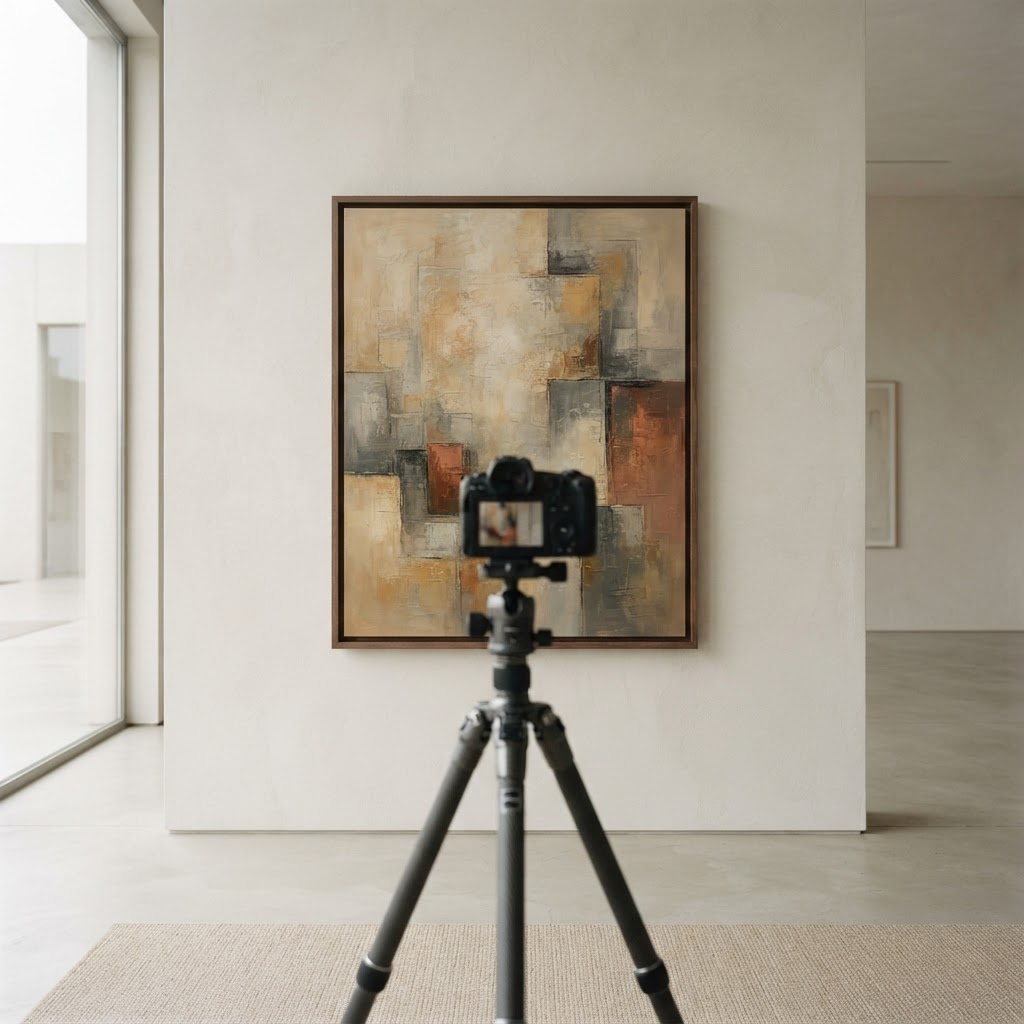
Meticulous presentation distinguishes your work in the marketplace. Serious collectors expect detailed provenance, condition assessment, and museum-quality photography.
Professional Presentation Standards
Gallery-standard practices to present your work at its finest.
Photography
- Use natural, diffused lighting to avoid harsh shadows
- Avoid glare on varnished or gloss surfaces
- Capture close-up detail shots of texture and brushwork
- Photograph the full frame and verso (back of work)
Documentation
- Certificate of Authenticity (COA) from the artist or gallery
- Provenance history - documented chain of ownership
- Original gallery invoices or purchase receipts
- Exhibition history and catalogue references
Pricing
Starting Bid
The lowest price you are willing to accept to open bidding. Setting this too high discourages early bids; too low may undervalue the work.
Reserve Price
An optional confidential minimum. The auction settles only if the highest bid meets or exceeds this amount. If the reserve is not met, the lot is unsold.
Market Demand
You may wish to consider comparable works by the same artist, current buyer interest in the style or medium, and the platform's recent auction trends when setting your pricing.
This information is provided for general guidance only and does not constitute valuation, appraisal, or financial advice.
Guidance by Medium
The guidance above is written with painting in mind, yet every medium carries its own conventions for documentation, photography, condition and packing. Choose yours below for guidance tailored to the work you make.
Works on canvas, panel or board. The baseline most of this guide is written around.
Documentation
- Title, medium and support stated plainly
- Year of completion and signature location noted
- Edition position within a series, or a clear statement that the work is unique
- A reference number traceable in your own records
- Prior conservation, if any, disclosed openly
Photography
- Full-front capture in natural, diffused light, square to the surface
- Detail of texture and brushwork, and of the signature
- The verso, including labels, stamps and inscriptions
- Avoid flash on varnished or gloss surfaces
- A scale or context reference where helpful
Condition
- Canvas tension or panel stability checked
- Surface examined for dust, flaking and active craquelure
- Prior restoration or retouching disclosed
- Frame and verso condition recorded
- A dated condition note kept on file
Packing & Shipping
- Glassine or acid-free tissue as the barrier, never bubble wrap on paint
- Rigid corner protectors on every stretched or framed work
- Foam cushioning over the barrier, then a snug box
- Cardboard on both faces to resist puncture
- A slat crate for impasto or high-value works
Best Practices for Documentation
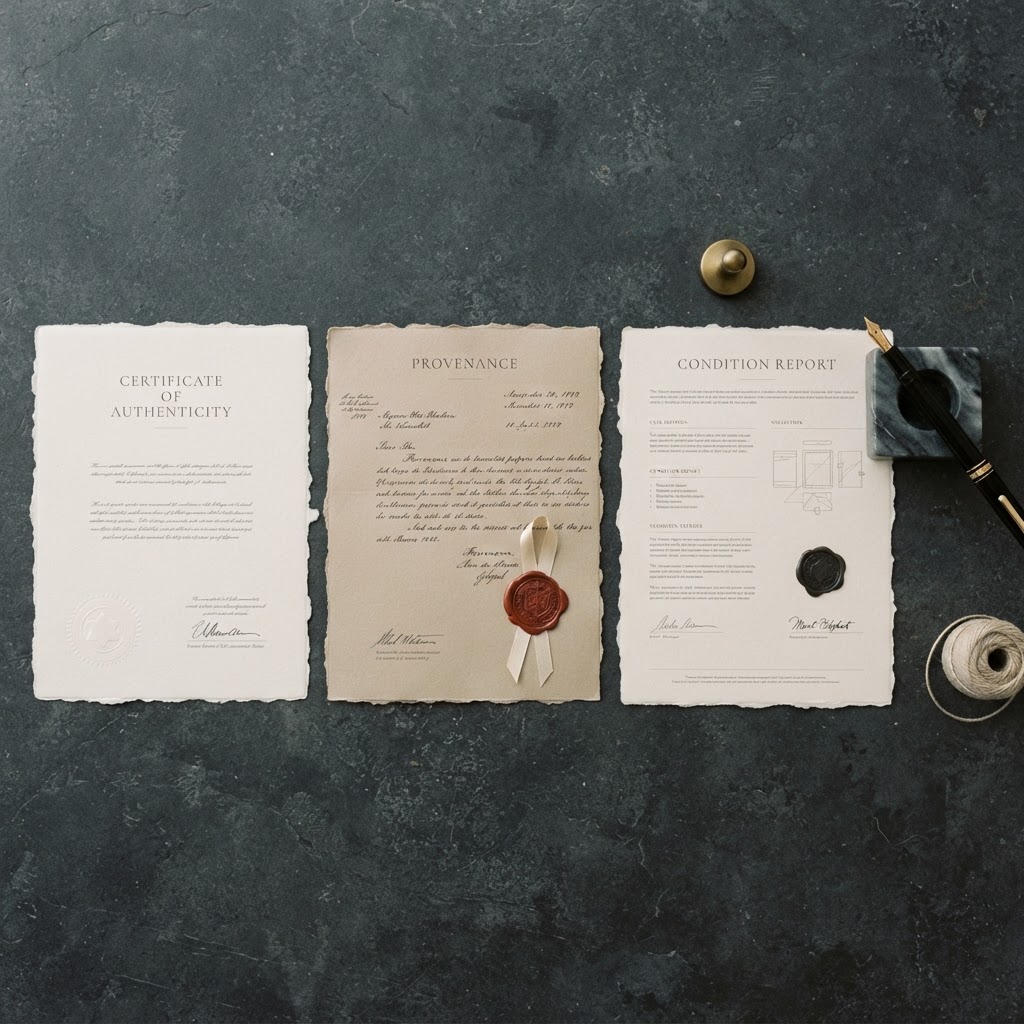
Why Documentation Sets Work Apart
Collectors commit more readily, and more quickly, when a work arrives with a clear record behind it. Well-kept documentation removes the hesitation that quietly ends most enquiries, and it distinguishes a considered consignor from a casual one. Think of the pages below as part of the presentation of the work, not as paperwork to be endured.
Informational only. The examples on this page illustrate common industry conventions for presenting documentation. They are not legal, appraisal or professional advice, and they are not platform requirements for listing. All documentation is provided by the consignor and is displayed as consignor-declared. Visionary Studios does not audit, authenticate or verify its contents, and cannot accept responsibility for its accuracy or completeness. Where a work carries significant value or an uncertain history, you may wish to consult an independent specialist.
Certificate of Authenticity
A single page, issued by whoever is in a position to stand behind the work: the artist, the studio, the estate, or the gallery that sold it. Its value lies in being specific.
What a strong record includes
- Artist name exactly as the work is signed
- Title, year, medium and unframed dimensions
- Edition details, or a clear statement that the work is unique
- Where and how the work is signed or marked
- A plain statement of authenticity, signed and dated
- A reference number you can trace in your own records
Specimen — Formatting Example
Certificate of Authenticity
Issued by the artist · No. 2024-014
- Artist
- Full legal name, as signed
- Title
- Title of the work
- Year
- Year of completion
- Medium
- e.g. Oil on linen
- Dimensions
- H x W x D, unframed, in cm and inches
- Edition
- Unique, or 3 of 25 plus 2 AP
- Signature
- Where and how the work is signed, e.g. verso, lower right
- Statement
- I certify that the work described above is an original work created by me.
Signature of issuer
Date
Provenance Record
A chronological account of who has held the work, from the studio to today. Collectors read provenance for continuity, so a short honest chain reads far better than a long vague one.
What a strong record includes
- One line per holder, earliest first
- Year of transfer, and how it passed on (purchase, gift, descent, consignment)
- City and country for each holder
- Galleries, dealers and auction houses named in full
- Gaps stated openly rather than smoothed over
- Supporting paperwork referenced where it exists
Specimen — Formatting Example
Provenance
- 2019Studio of the artist, Lisbon
- 2019Galeria Norte, Lisbon (acquired directly from the artist)
- 2021Private collection, Dublin (acquired from the above)
- 2024Present consignor (by descent)
Listed earliest to most recent. Each line states who held the work and how it passed to the next holder. Gaps are stated plainly rather than guessed at, e.g. "Whereabouts unrecorded, 1998-2004".
Recording uncertain dates
- 1955-1970
- Held in this collection for that whole period
- 1955-
- Entered in 1955; when it left is unknown
- -1955
- Left in 1955; when it was acquired is unknown
- by 1955
- Certainly held by 1955, possibly earlier
- c.1955
- Approximate date, indicated by the sources
- 1950s
- Only the decade can be established
Museum convention. Using it signals that your record was kept carefully rather than reconstructed from memory.
Catalogue Raisonné Reference
Where a recognised catalogue of the artist exists and this work appears in it, cite the entry precisely. A precise citation can be checked; a vague mention cannot.
What a strong record includes
- Author or editor of the catalogue
- Full publication title and volume
- Publisher, place and year of the edition
- The catalogue number for this specific work
- Page or plate where the work is illustrated
- A link to the online entry, if one is published
Specimen — Formatting Example
Catalogue Raisonné Reference
Ferreira, M. Ana Duarte: Paintings 1996-2018, Catalogue Raisonné, Vol. II, Éditions Marceau, Paris, 2020, cat. no. 412, illustrated p. 287.
Author / Editor — who compiled the catalogue
Title & Volume — the exact publication, in italics
Publisher, Place, Year — the edition consulted
Catalogue Number — the entry for this specific work
Page / Plate — where it is illustrated
If the work is under review for inclusion, say so and give the date of submission rather than implying it is already listed.
Condition Report
A factual record of the physical state of the work at the point of sale. It protects both seller and buyer: it sets the baseline against which transit damage is judged, and it demonstrates that the consignor has examined the work properly rather than selling blind.
What a strong record includes
- Date of inspection and lighting conditions used
- Support stability - tears, creases, canvas tension, panel warp
- Surface - dust, flaking, cupping, retouching visible under UV
- Craquelure pattern, noted as stable or active
- Prior restoration or conservation, disclosed openly
- Frame and verso, including labels, stamps and inscriptions
Specimen — Formatting Example
Condition Report
Prepared by the consignor · No. 2024-014-C
- Work
- Title, artist, year (as on COA)
- Examined
- Date of inspection, and by whom
- Lighting
- Raking light, daylight, normal room light
Findings
- SupportStable. No tears, punctures or creases. Canvas tension even.
- SurfaceMinor dust accumulation in lower texture recesses. No flaking or cupping.
- CraquelureStable hairline network across upper sky, consistent with age. No lifting.
- RetouchingTwo small spots visible under UV in lower left quadrant, likely prior restoration.
- FrameOriginal frame, structurally sound. Minor abrasion to lower right corner.
- VersoOriginal canvas, unstretched marks present. Gallery label upper left.
Prepared by
Date
State what was checked, what was found, and what could not be assessed. A note that the verso was unexamined behind a backing board is stronger than silence.
What Strengthens Documentation
Experienced collectors and appraisers look for these. Each one quietly builds confidence and reassures a careful buyer.
Date every certificate in full, including the year
State the edition details, or state plainly that the work is unique
Name a city and country for every private collection in your provenance
Pair any stamp with an original signature beside it
Cite the specific catalogue number, not just the title
Back a condition description with the detail behind it, not a bare "excellent"
Documentation Maturity
A quick self-assessment of where your records sit today, and what the next step looks like.
Tier 1
Essential
A COA or purchase record and a clear statement of how the work came to you.
Next step — Add a dated condition note and photograph the verso.
Tier 2
Strengthened
COA plus provenance with named holders, and a basic condition record.
Next step — Cite any catalogue raisonné reference and gather original invoices.
Tier 3
Comprehensive
Full chain of ownership, condition report, exhibition history, and catalogue citations.
Next step — Keep the folder updated at each transit; a living record holds its value.
If You Have No Documentation Yet
Most sellers begin here. A record started today, kept consistently, is worth more than one assembled under pressure years from now.
You have nothing on paper yet
Begin today rather than reconstructing later. For your own work, write a certificate at the point of completion and keep a numbered register of every piece. For a work you bought, start the record with your own acquisition and state plainly that no earlier ownership record was supplied to you.
You have paperwork, but it is scattered
Gather what exists into one folder per artwork: purchase invoice, gallery correspondence, exhibition labels, framing receipts, insurance schedules, delivery notes. Scan each item flat and legibly. A tidy folder of ordinary receipts is stronger evidence than a single impressive-looking certificate.
You bought the work privately
Ask the person you bought it from for a short signed note stating what they sold you, when, and where they acquired it. Most sellers will provide this if asked politely. Keep the original message thread or bank reference alongside it.
The artist is living and reachable
A brief written confirmation from the artist, or from the gallery that represents them, is often obtainable and carries real weight. Ask for a signed statement referencing the specific title, year and dimensions.
The history genuinely cannot be traced
Say so. Describe what you do know, how the work came to you, and what you have been unable to establish. Collectors are experienced enough to price an honest gap. What damages a sale is a claim that does not hold up.
Clarity matters more than polish. A plainly typed record that is accurate, dated and complete presents better than an ornate certificate that cannot be substantiated.
How Your Documentation Appears Publicly
When a work sells on Visionary Studios, its sale is recorded in our public Provenance Register - an anonymised, certificate-backed ownership history visible to anyone. The provenance text and exhibition history you provide at listing become part of that permanent record. Thorough documentation today becomes the verifiable provenance that collectors, appraisers, and future owners rely on tomorrow.
View the Provenance RegisterPreparing Artwork for Shipment

Disclaimer: This guidance is provided for informational purposes only. As the seller, you are solely responsible for arranging shipment and all delivery logistics directly with the buyer. Visionary Studios provides the platform facilitating the transaction but does not participate in shipping or fulfillment.
A work is only as well sold as it is well delivered. The guidance below reflects conservation and fine-art logistics practice used internationally, condensed into what a seller can actually carry out from a studio or a home. Read it once in full before your first dispatch.
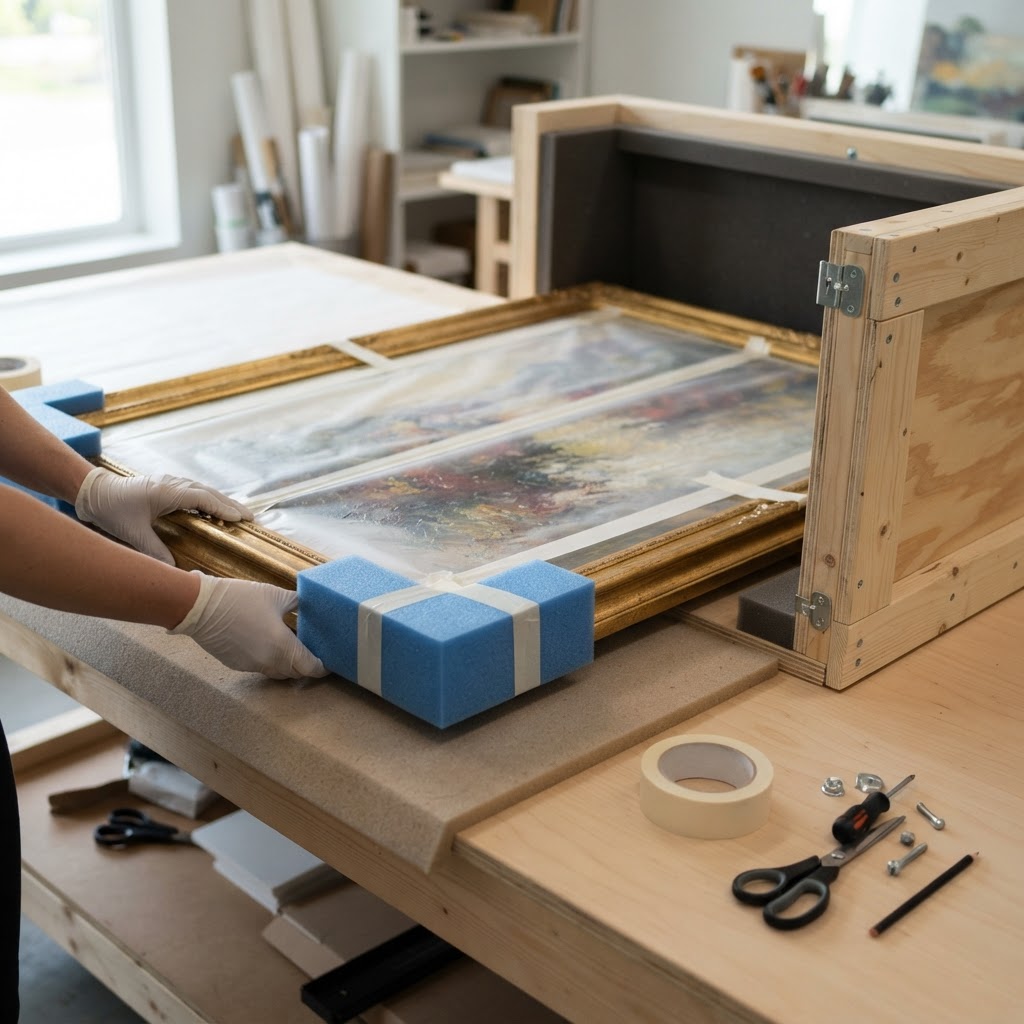
The Order of Layers
Most transit damage is not caused by impact. It is caused by the wrong material touching the surface, or by the work being able to move inside its container. Build outward in this order.
Build outward, in this sequence
Against the surface
Glassine, acid-free tissue, or a thin inert film. Never plastic wrap, newspaper, or bubble wrap in direct contact with a painted, gilded, or unvarnished surface.
Edges and corners
Rigid corner protectors on every framed or stretched work. Corners absorb almost every impact a parcel receives.
Cushioning
Closed-cell foam or bubble wrap, applied over the barrier layer, never against the work itself. Enough to prevent movement, not enough to compress the surface.
Rigid shell
A snug-fitting box, rigid boards on both faces, or a crate. The work must not shift when the container is tilted or shaken gently.
Outer container
Double box for anything travelling by standard parcel carrier, with cushioning in the void between the two boxes.
The single most common and most costly error is bubble wrap pressed directly against paint. Under warmth and pressure it can lift or emboss a surface permanently. Always place a barrier layer first.
Handling discipline
- Two people for anything wider than your arm span, always.
- Carry a stretched canvas by the stretcher bars, never by the top rail alone and never by the frame moulding.
- Clean cotton or nitrile gloves for gilded frames, unvarnished paint, metal, and photographs.
- Never lean a work face-in against a textured or rough wall while you prepare materials.
- Work on a clean padded surface, and clear the room of drinks, pets, and loose tools first.
Method by Format
The correct method depends on the surface and the structure, not on the value alone.
Stretched canvas, smooth or lightly textured
- Glassine or acid-free tissue across the painted face, taped to the stretcher bars only and never to the paint.
- Rigid corner protectors on all four corners.
- Foam or bubble wrap over the barrier layer, then a snug box.
- Cardboard cut to size on both faces to resist puncture.
Heavily textured, impasto, or high-value canvas
- Never compress a raised surface. Cushioning must not touch it.
- Use a slat crate (also called a travel crate): a light braced frame that holds all packing material clear of the surface.
- Full custom crating with foam-lined cavities for significant works.
- A face-mounted rigid cover board, spaced off the surface, where the texture is very pronounced.
Framed works and glazed works
- Where glass is present, apply low-tack painter’s tape in an X across the glazing so shards are held together if it breaks.
- Better still, remove the glass and ship it separately, or reglaze in acrylic where the buyer accepts it.
- Rigid board on both faces of the frame, plus corner protectors.
- Double box, with cushioning between inner and outer.
Unframed works on paper
- Acid-free sleeve or folder, then sandwiched between two rigid boards taped closed.
- Seal against humidity with a sealed polythene layer outside the boards, not inside.
- Never roll a work that has been stored flat, and never flatten one that has been stored rolled.
- If a roll is unavoidable, use a wide-diameter tube, image facing outward, interleaved with tissue.
Sculpture and three-dimensional work
- Remove every detachable element, wrap and label each separately, and include a reassembly note.
- Cushion protruding features individually before the object is cushioned as a whole.
- Dense foam cut to the form, so the object is cradled rather than merely surrounded.
- Support the base fully and confirm the object cannot shift or rotate inside the container.
Crate specification you can hand to a joiner
If you are commissioning a crate locally rather than buying one, these figures reflect widely used international crating practice and align with published commercial crating standards such as ASTM D6251.
- Panels of 12.5 mm (1/2 in.) plywood or thicker for domestic and international transport.
- Base panel of 19 mm (3/4 in.) plywood, as the base carries the load.
- Reinforcing battens at roughly 60 cm (24 in.) intervals across wider panels.
- Interior lined with foam or a barrier layer, so bare timber never contacts the work.
- Screwed, not nailed, so the crate can be opened and reused without shock or prising.
- Waterproof labelling in characters at least 8 mm high, applied to two opposite faces.
- Orientation and handling marks on all four sides.
Timber crates crossing borders may need to meet international phytosanitary rules for wood packaging (ISPM 15), which require heat-treated or fumigated timber carrying the appropriate stamp. Ask your supplier to confirm compliance before you book.
The Pre-Shipment Record
This is the most valuable half hour you will spend. If a work is ever reported damaged, the record you made before it left the studio is the only evidence that establishes the condition it left in. Make it every single time.
Images to capture, before packing
- Straight-on full view of the front, evenly lit, whole work in frame.
- Raking light across the surface (a lamp low to one side), which reveals texture, lifting, and dents that flat light hides.
- Close-up of every existing flaw, however minor, with something for scale.
- All four corners individually.
- The verso, including stretcher, labels, stamps, and any inscriptions.
- The signature, and any edition or foundry mark.
- The frame, including its own condition.
Then photograph the packing itself
- The work laid out with its barrier layer applied.
- Corner protectors and cushioning in place.
- The work inside its box or crate before closing.
- The sealed container with the shipping label legible.
- The carrier receipt, tracking reference, and insurance schedule.
A sequence of dated images showing competent packing is the strongest answer there is to a claim that a work was badly packed.
Specimen: written condition note
Condition Record at Dispatch
Work: Coastal Study No. 4
Artist: A. N. Example
Medium: Oil on linen, unframed
Dimensions: 90 x 70 cm (35 3/8 x 27 1/2 in.), unframed
Weight as packed: 6.4 kg
Surface: Sound and stable. Varnish even. No cracking, cupping, or losses observed under raking light.
Existing marks: Minor rub to the lower left tacking edge, approx. 8 mm, present since completion. Photographed.
Support: Stretcher square and keyed. Canvas tension even.
Packed: Glassine face layer, foam corner protectors, 25 mm foam, slat crate, screwed closed.
Examined and packed by: A. N. Example
Date: 14 August 2026
Images: 18 files, retained, reference CS4-DISPATCH
Illustrative example only. Send a copy to your buyer at dispatch and keep the original with your records.
Transit Conditions and Crossing Borders
Two areas where disputes can be avoided with the right care and attention.
Climate, curing, and unpacking
- Sudden changes in temperature and humidity can cause more harm to art in transit than impact does.
- Works should be fully cured before packing — oil paint in particular can remain soft for months and may imprint against any covering.
- Avoid sealing a cold work in plastic, which can trap condensation against the surface.
- Let your buyer know, in writing, to let the package acclimatise indoors for several hours — ideally 24 — before opening it.
- Ask the buyer to unpack over a clean, padded surface, keep all packaging until they have inspected the work, and photograph anything of concern immediately.
For higher-value works, consider a specialist fine-art logistics provider rather than a standard courier \u2014 they manage climate, handling and condition reporting end to end, and that is typically reflected in the price you set.
General best-practice guidance only, not professional conservation or shipping instructions. The platform does not verify, endorse or warrant any third-party shipper.
International paperwork
Requirements vary by country and change over time. Treat the following as the usual shape of the paperwork, and confirm the specifics with your carrier, a customs broker, or the destination authority before you ship.
Commercial invoice
Required for any sale crossing a customs border. Full description of the work, artist, medium, dimensions, declared value, currency, and both parties’ details.
Tariff classification
Original paintings, drawings, prints, and sculpture are generally classified under headings 9701 to 9703 of the Harmonised System, which in many territories attract a reduced or zero duty rate. Declaring a work as a decorative good instead can cost your buyer significantly.
Artist’s declaration
A short signed statement that the work is an original executed entirely by hand supports the classification above. Customs officers frequently ask for it.
Proforma invoice
Used where the work travels without a sale, for example to an exhibition, with a stated value for customs purposes only.
Country of origin
Generally the artist’s nationality or the country of creation, not the country you are posting from. State it consistently across all documents.
Frames and mounts
Some territories classify a frame separately from the work. Itemise it on the invoice where its value is meaningful.
Never understate a declared value to reduce duty. It is unlawful in most territories, and it caps what any insurer will pay if the work is lost. Certain materials, including ivory, tortoiseshell, some feathers, and certain hardwoods, are restricted or prohibited under wildlife trade rules regardless of the age of the work.
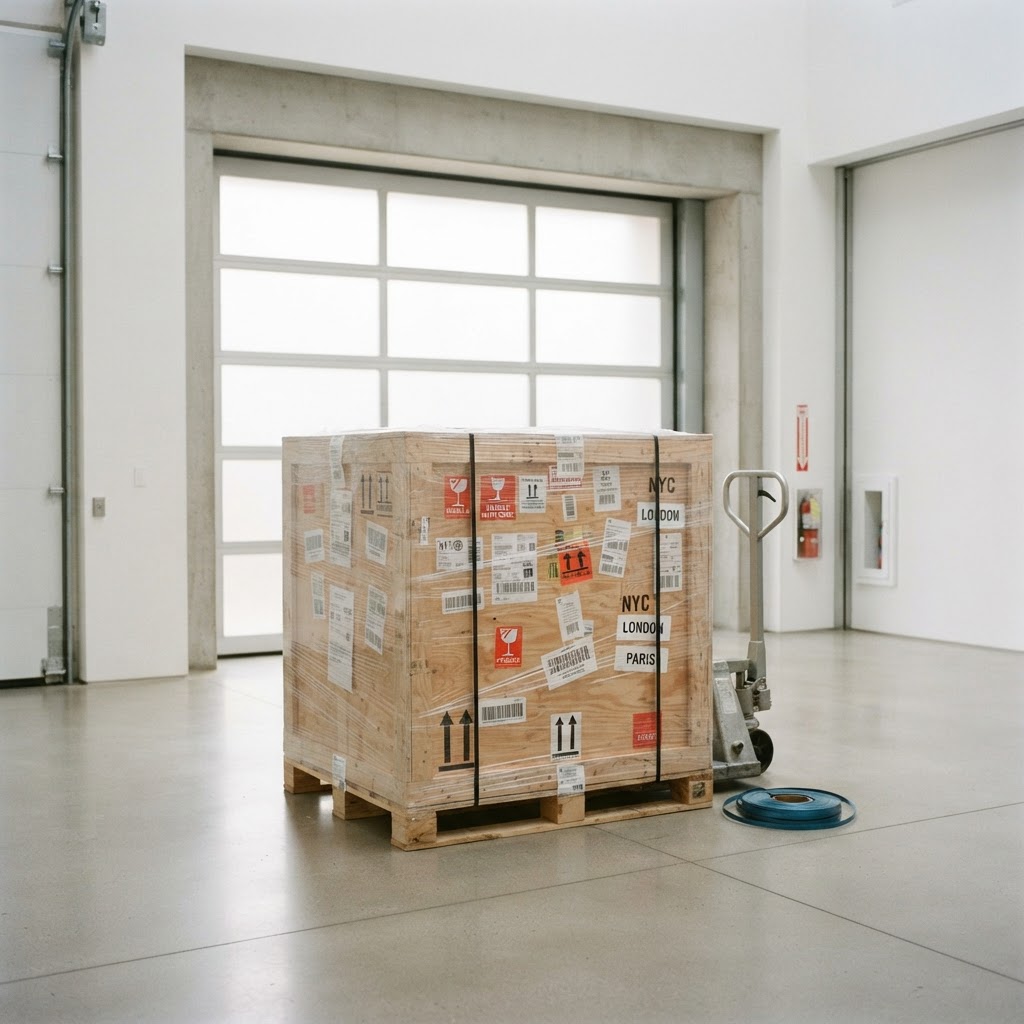
Agreeing and Recovering Shipping Costs
Shipping is arranged and paid for between you and your buyer. Handled openly it is a non-event. Handled late, or vaguely, it is the most common source of friction after an otherwise clean sale.
If your listed price already includes shipping, you’re done — there is nothing further to arrange, and you should not invoice the buyer separately.
If it does not, the cost must be agreed and recovered directly with your buyer, since Visionary Studios does not process shipping payments. Follow the steps below.
State it before the sale, wherever possible
The cleanest position is one where nothing needs negotiating afterwards. Say in your listing description whether carriage is included, charged at cost, or quoted on request by destination. A buyer who knows the position before bidding rarely disputes it after.
Quote in writing, with the carrier figure attached
Once you have the destination address, obtain a real quotation and pass it on as it stands: carrier, service, transit time, insured value, and the amount. A forwarded quotation reads as a cost being recovered. A round number invented afterwards reads as a charge being added.
Itemise packing separately from carriage
Crating, materials, and specialist packing are legitimate costs and are best shown as their own line rather than absorbed into a single figure. Buyers accept them readily when they can see what they are.
Issue a short shipping invoice
A simple document is enough: your name and address, the buyer’s, the artwork title and platform order reference, the itemised amounts, the total, your VAT or tax number if you are registered, payment details, and the date. Keep the numbering sequential with your other records.
Get agreement before you book
Wait for the buyer to confirm the amount in writing through platform messaging before you commit to a carrier. That message is your record if the figure is ever questioned.
Keep every receipt
Carrier receipt, packing materials, crate, insurance schedule. If a buyer later queries the charge, an itemised set of receipts settles it in one message.
Two boundaries to observe. Visionary Studios does not process, collect, or hold shipping payments, and takes no commission on them, so any shipping sum is settled directly between you and your buyer. And the price of the artwork itself must always be paid through the platform. Never invite a buyer to pay for the work outside it, whether framed as a discount, a combined figure, or a convenience. Doing so removes the buyer’s protections, voids your transaction record, and is grounds for removal.
General guidance only. Tax treatment of carriage and packing charges differs by territory and by your own registration status. Where a sale is significant, or crosses a border, take your own professional advice.
Coordinating with your buyer
Once the transaction is confirmed, contact the buyer through platform messaging to coordinate delivery. Agree the shipping method, the timeline, and who bears the cost. Always use insured, tracked carriage from a reputable carrier, and confirm before booking that the policy covers fine art rather than general goods, since many standard policies exclude it or cap it well below the sale value. Send the buyer the tracking reference and your condition record at dispatch, and retain all delivery documentation. Where a work is large, fragile, or of significant value, a specialist fine-art shipper is usually the correct choice rather than a parcel carrier.
Paperwork for a Sale
A professional sale involves a small set of documents, and knowing who issues which avoids questions later. Some are produced by the platform automatically; others remain yours to provide as the seller of record.
Issued by Visionary Studios
Order Confirmation & Payment Receipt
Issued to the buyer automatically when the sale is confirmed.
Certificate of Acquisition
Generated for the buyer once payment is confirmed. It records the acquisition itself — the platform does not authenticate or appraise the work.
Transaction Record
A timestamped PDF of the order timeline and correspondence, available to both parties from the order page.
Confirmation of Sale & Remittance Advice
Your seller-side document showing the sale figure, commission and net remittance.
Issued by You, the Seller
Sales invoice (if the buyer requires one)
Particularly for business and gallery buyers — see the note below.
Certificate of Authenticity
If you provide one with your work, send it with the piece and mention it in your listing.
Provenance documentation
Earlier invoices, exhibition history or catalogue references supporting the work's history.
Condition statement
A short record of the work’s condition at listing time — and again at dispatch, alongside your pre-shipment photographs.
Your buyer may ask you for an invoice
You are the seller of record for your artwork. If your buyer requests a formal sales invoice — business and gallery buyers in particular often require one for their own records — it is yours to issue, showing the artwork, the sale price and your details. Visionary Studios facilitates the transaction via Stripe Connect and provides the order receipt and Certificate of Acquisition, but does not issue tax invoices for artworks in its own name.
Insurance & Evidence of Value
Use insured, tracked carriage and keep the transit insurance certificate alongside your dispatch records. Collectors often also insure a newly acquired work under their own policy, and their insurer will usually ask for evidence of value — an up-to-date independent appraisal is the document normally accepted for that purpose.
Browse Appraisers →Visionary Studios does not appraise, value or authenticate works. Appraisals are prepared solely by independent third-party professionals.
If a Payment Is Disputed
Occasionally, a buyer questions a card charge with their own bank rather than contacting you directly — this is called a payment review, or a chargeback. It happens sometimes with card payments generally, and on its own is not a sign that anything has gone wrong on your part.
You will be notified by email and in your dashboard the moment one opens, with a clear deadline. Your payout for that order is paused until it is resolved — this is routine and protects both sides while the review is open.
Open the order in your dashboard and you will see a Payment Review panel. Add your tracking number, carrier, shipment and delivery dates, and a proof of shipment or delivery if you have one — a short statement in your own words helps too.
Submit before the deadline shown — Visionary Studios forwards what you provide to Stripe on your behalf. The deadline is set by your buyer's card issuer, not the platform, and cannot be extended.
You will hear the outcome either way. Stripe and the buyer's card issuer decide the outcome independently — Visionary Studios does not judge the dispute itself. If it is resolved in your favour, your payout resumes on the normal schedule.
The best protection against a payment review going against you is straightforward: always use tracked, insured shipping (see Section 06) and keep your proof of dispatch and delivery on hand — the same records you would want for insurance purposes anyway.
Paid Placements
Featured Works Placement
A one-time, fixed-term placement in the homepage's Featured Works section for any of your approved, public listings. No subscription — buying again after your term expires simply renews it.
€49
7 days
€89
14 days
€149
30 days
Prices shown are net of VAT — the final amount including any applicable VAT is shown at checkout. Purchase from the "My Artworks" tab of your dashboard, under each eligible listing. Activation is immediate, so the statutory right of withdrawal does not apply once purchased.
Homepage Hero Placement
One work, presented full-bleed on the gallery wall every visitor sees first when they land on the homepage — complete with a museum label linking straight to your work's page. Verified sellers only, buy-now works only, one work at a time on a monthly term, at a flat monthly premium. Placement is always disclosed on the label itself.
Learn more & request placementWhy a single placement outperforms a grid listing
This isn't our own measured data. It's a rough illustration of two well-established findings in web-attention research: eye-tracking studies (Nielsen Norman Group) consistently show a page's top region gets disproportionately more visual attention than content further down, and viewability research (comScore, cited by Google/Think with Google) has found that roughly half of below-the-fold content is never seen at all. A single full-bleed placement with no competing thumbnails sits squarely in the zone that gets seen — which is the mechanism, not a promised outcome.